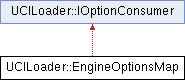
Container and iterator for engine option proxies. More...
#include <EngineConnection.h>
Public Types | |
| using | map_iterator = Map::iterator |
Public Member Functions | |
| EngineOptionsMap (const std::shared_ptr< AbstractPipeWriter > &writer) | |
| EngineOptionProxy & | get (const std::string &id) |
| const EngineOptionProxy & | get (const std::string &id) const |
| bool | contains (const std::string &id) const |
| Check if the engine has an option with the specified name. | |
| iterator | begin () |
| Get iterator to the first option. | |
| iterator | end () |
| Get iterator to one past the last option. | |
| EngineOptionProxy & | operator[] (const std::string &id) |
| Access option by name using bracket notation. | |
| const EngineOptionProxy & | operator[] (const std::string &id) const |
| Access option by name using bracket notation (const version). | |
Detailed Description
Container and iterator for engine option proxies.
EngineOptionsMap acts as a map-like container populated from engine's option responses during UCI initialization. Access options by name using the [] operator or iterate over all options using begin() and end().
Options are populated automatically as the engine sends its option declarations. It's recommended to call sync() on the EngineInstance to ensure all options are loaded before accessing this map. It's recommended to call sync() before querying options to ensure completeness.
Usage:
- See also
- EngineInstance::sync() for populating options
Member Function Documentation
◆ begin()
|
inline |
Get iterator to the first option.
- Returns
- Iterator pointing to the first EngineOptionProxy
◆ contains()
|
inline |
Check if the engine has an option with the specified name.
- Parameters
-
id The option identifier to check
- Returns
- True if the option exists, false otherwise
◆ end()
|
inline |
Get iterator to one past the last option.
- Returns
- Iterator pointing past the last EngineOptionProxy
◆ operator[]() [1/2]
|
inline |
Access option by name using bracket notation.
- Parameters
-
id The option identifier
- Returns
- Reference to the EngineOptionProxy for the specified option
- Exceptions
-
std::out_of_range if the option doesn't exist
◆ operator[]() [2/2]
|
inline |
Access option by name using bracket notation (const version).
- Parameters
-
id The option identifier
- Returns
- Const reference to the EngineOptionProxy for the specified option
- Exceptions
-
std::out_of_range if the option doesn't exist
The documentation for this class was generated from the following file:
- include/UCILoader/EngineConnection.h