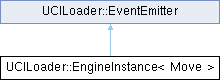
Top-level interface for managing and interacting with a UCI chess engine. More...
#include <EngineConnection.h>
Classes | |
| class | EngineBusyException |
| Exception thrown when attempting to start a search while one is already in progress. More... | |
| class | TimeoutException |
| Exception thrown when a sync() or ping() operation times out. More... | |
Public Member Functions | |
| EngineInstance (std::shared_ptr< ProcessWrapper > engineProcess, std::shared_ptr< Marschaler< Move > > moveMarshaler, std::shared_ptr< PatternMatcher > moveValidator, std::unique_ptr< Logger > &&logger) | |
| void | sync (std::chrono::milliseconds timeout=std::chrono::milliseconds(10000)) |
| Synchronize engine state with local representation. | |
| void | ucinewgame () |
| Send the ucinewgame command to the engine. | |
| std::chrono::milliseconds | ping (std::chrono::milliseconds timeout=std::chrono::milliseconds(10000)) |
| Measure engine latency by performing a ping operation. | |
| std::shared_ptr< SearchConnection< Move > > | getCurrentSearch () |
| Get the currently active search connection. | |
| std::shared_ptr< SearchConnection< Move > > | search (const GoParams< Move > ¶ms, const PositionFormatter &pos, const std::vector< Move > moves={}) |
| Start a new search operation with specified parameters. | |
| std::string | getName () |
| Get the engine's name as declared via the id name command. | |
| std::string | getAuthor () |
| Get the engine author's name as declared via the id author command. | |
| bool | healthCheck () |
| Check the health status of the underlying engine process. | |
| void | quit () |
| Manually terminate the engine process. | |
 Public Member Functions inherited from UCILoader::EventEmitter Public Member Functions inherited from UCILoader::EventEmitter | |
| void | unlink (const EventReceiver *receiver) |
| Disconnect a specific receiver from future events. | |
| void | connect (std::shared_ptr< EventReceiver > receiver) |
| Connect a custom event receiver. | |
| void | connect (std::function< void(const EngineEvent *)> callback, uint32_t eventFilter) |
| Connect a callback function that receives the full event. | |
| void | connect (std::function< void()> callback, uint32_t eventFilter) |
| Connect a simple parameterless callback function. | |
Public Attributes | |
| EngineOptionsMap | options |
| Map of available engine options. | |
Additional Inherited Members | |
| Protected Member Functions inherited from UCILoader::EventEmitter | |
| virtual | ~EventEmitter () |
| Virtual destructor ensuring proper cleanup. | |
| void | emit (const EngineEvent *event) |
| Emit an event to all connected receivers. | |
Detailed Description
class UCILoader::EngineInstance< Move >
Top-level interface for managing and interacting with a UCI chess engine.
- Template Parameters
-
Move The move type used by the engine
EngineInstance is the primary interface for communicating with a chess engine over UCI protocol. It handles:
- Engine initialization and synchronization
- Option management and configuration
- Search operations and result retrieval
- Event emission for status changes
- Graceful shutdown
Typical Usage:
- Warning
- Always call sync() after construction to ensure engine options and metadata are loaded.
- See also
- EngineInstanceBuilder for creating instances
- Logger for configuring logging behavior
Member Function Documentation
◆ getAuthor()
|
inline |
Get the engine author's name as declared via the id author command.
- Returns
- The author name, or "<empty>" if not provided by the engine
It's recommended to call sync() before querying this to ensure the author name has been received and loaded.
◆ getCurrentSearch()
|
inline |
Get the currently active search connection.
- Returns
- Shared pointer to the current SearchConnection, or nullptr if no search is in progress
◆ getName()
|
inline |
Get the engine's name as declared via the id name command.
- Returns
- The engine name, or "<empty>" if not provided by the engine
It's recommended to call sync() before querying this to ensure the engine name has been received and loaded.
◆ healthCheck()
|
inline |
Check the health status of the underlying engine process.
- Returns
- True if the engine process is alive and responsive, false if it has been terminated
If this method returns false, the EngineInstance is in an unstable state and should not be used further.
◆ ping()
|
inline |
Measure engine latency by performing a ping operation.
This is a convenience wrapper around sync() that measures the round-trip time.
- Parameters
-
timeout Maximum time to wait for engine response (default 10 seconds)
- Returns
- The latency in milliseconds
- Exceptions
-
TimeoutException if engine fails to respond within timeout period
◆ quit()
|
inline |
Manually terminate the engine process.
Note: Manually calling this method is unnecessary. The engine will be automatically terminated when the EngineInstance object goes out of scope via the destructor.
However, manual termination is allowed for exceptional cases, such as when the engine becomes stuck in an infinite loop or is otherwise unresponsive. In such scenarios, calling quit() will forcibly shut down the engine process.
- Warning
- Important: After calling quit() manually, the EngineInstance object becomes unusable. Do not attempt to perform any operations other than health check (search, sync, option configuration, etc.) on the EngineInstance after calling this method.
◆ search()
|
inline |
Start a new search operation with specified parameters.
- Template Parameters
-
Move The move type
- Parameters
-
params Search parameters (time, depth, nodes, etc.) - see GoParamsBuilder from UCI.h pos Root position to analyze - must implement PositionFormatter interface moves Sequence of moves to play before the search position (useful for openings)
- Returns
- Shared pointer to the SearchConnection for monitoring and controlling the search
- Exceptions
-
EngineBusyException if a search is already in progress
Example with StandardChess variant:
The position parameter determines the root position, while moves specify which moves the engine must play before reaching the actual search position.
◆ sync()
|
inline |
Synchronize engine state with local representation.
Sends an 'isready' command to the engine and waits for the 'readyok' response. This ensures the engine is responsive and have all options and metadata (name, author) loaded.
This method should be called after constructing an EngineInstance and before performing operations like querying options or starting searches.
- Parameters
-
timeout Maximum time to wait for engine response (default 10 seconds)
- Exceptions
-
TimeoutException if engine fails to respond within timeout period
If a timeout occurs, the engine process will be terminated and this exception thrown. After a timeout, the EngineInstance should be considered unusable.
◆ ucinewgame()
|
inline |
Send the ucinewgame command to the engine.
Instructs the engine to reset its internal state (typically clearing the transposition table) before starting future searches. Useful when starting a new game or test suite.
Member Data Documentation
◆ options
| EngineOptionsMap UCILoader::EngineInstance< Move >::options |
Map of available engine options.
Populated automatically from UCI option responses. Use sync() to ensure all options are loaded.
The documentation for this class was generated from the following file:
- include/UCILoader/EngineConnection.h